

25/03/2026
The first event of the “COP31 Insights” webinar series, launched by the Istanbul Policy Center (IPC) as part of the preparations for COP31, was held online on March 17, 2026. Open to international participation, the webinar addressed current developments and global expectations regarding the COP31 process from different perspectives.
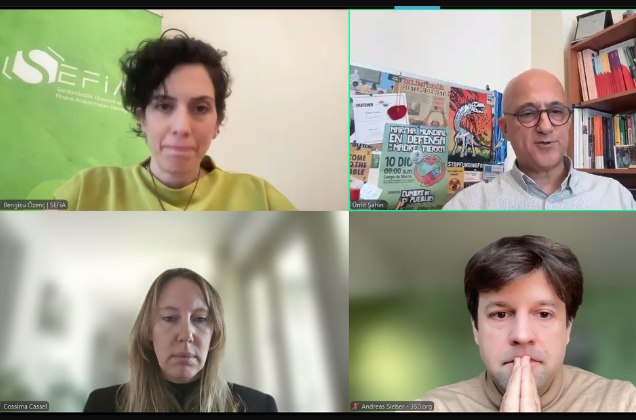
The event was moderated by Ümit Şahin, Coordinator of the IPC Climate Change Program, while speakers included Andreas Sieber (350.org), Bengisu Özenç (Sustainable Economy and Finance Research Association), and Cosima Cassel (E3G). The session, which brought together participants from different countries, was the first step in a series aimed at fostering dialogue among international climate policy communities before COP31.
COP31 Preparation Process and Presidency Structure
In the first part of the webinar, the preparation process and presidency structure of COP31, which will be held in Antalya under the auspices of Türkiye, were discussed. It was emphasized that the cooperation model established between Türkiye and Australia is one of the most striking elements of COP31, with Türkiye emerging as the host and chair country, while Australia will take an active role in the negotiation processes.
Furthermore, it was pointed out that COP31 is not only about negotiation processes; it offers a multi-layered structure shaped by an Action Agenda and the participation of different stakeholders. In this context, information was shared about the meetings held, consultation mechanisms, and institutional structure created during the preparation process.
Action Agenda and Priorities
One of the prominent topics in the event was the COP31 action agenda. It was stated that areas such as clean energy transition, zero waste and methane reduction, climate-resilient cities, and green industrialization are among the priority topics within the scope of COP31.
It was stated that the action agenda is still in the shaping stage and continues to develop through different drafts, and it was emphasized that this process is progressing with the contributions of both national and international actors. Throughout the webinar, the need to increase the feasibility of the action agenda and produce concrete results was among the common points that stood out.
Global Context and Negotiation Agenda
Another important part of the webinar addressed the global context in which COP31 is taking shape. It was stated that geopolitical uncertainties, energy security discussions, and transformations in the multilateral system directly affect climate negotiations by 2026.
In this context, it was emphasized that COP31 should be evaluated not only with its technical negotiation topics but also with its international collaborations, financing mechanisms, and implementation processes. Accelerating the implementation in line with the Paris Agreement targets and maintaining the 1.5°C target were also among the prominent topics.
Civil Society and International Cooperation
The participation of civil society organizations and different stakeholders in the COP processes was also discussed in the webinar. The importance of strengthening dialogue and cooperation among different actors was emphasized in order for climate policies to be more inclusive and effective. In this regard, it was stated that COP31 is not only an intergovernmental process but also a platform offering a broader scope for participation.
Ongoing Dialogue Towards COP31
The first session of the “COP31 Insights” webinar series attracted attention by providing an international discussion platform bringing together different stakeholders before COP31. Assessments were made within a broad framework ranging from the COP31 presidency structure and action agenda to global developments and negotiation priorities.
The webinar series, organized by the Istanbul Policy Center, is planned to continue in the coming period, addressing different topics in the process leading up to COP31.


